
ChatGPT as the Universal Control Plane: Why Every B2B App is About to Become a Backend Service
I haven’t logged into our CRM in 15+ years. Not my thing. Never will be.
I appreciate our CRM, it’s just as the “CEO”, the “boss”, it’s not worth my time. Folks can just send me updates, such as they are.
But asking ChatGPT about our sales performance? Getting instant answers about which rep is crushing it and why? Understanding which scripts convert and which customers need attention?
That I’m now all-in on.
It’s not just better UX. It’s so much more than that. I can do so much more. ChatGPT is fast becoming the universal control plane for business software. Or less technically, that’s ChatGPT beginning to become the front end for all B2B services. And remaking them in the process.
Especially any app that is, at its core, a database and workflows.
The New B2B Operating System?
OpenAI isn’t setting out necessarily to replace every B2B interface. They built the dominant conversational AI. But by now connecting ChatGPT to business systems through APIs and connectors, they’ve begun to create something far more powerful:
The universal control plane for enterprise software.
Think about what’s happening here. ChatGPT isn’t just another app in your stack—it’s becoming the interface for your entire stack. Your CRM, project management, analytics, HR systems, and more all become backend services that ChatGPT orchestrates through conversation.
This isn’t ChatGPT as a feature. This is ChatGPT as both the primary front end and the core infrastructure of business applications.

From App-Centric to Conversation-Centric
The traditional B2B model assumes you want to “use” individual applications:
- Log into Salesforce or HubSpot to check pipeline
- Switch to Monday or Asana for project updates
- Jump to Slack for team communication
- Open Amplitude or Tableau for analytics
ChatGPT is now flipping this entirely. Instead of you adapting to multiple interfaces, one conversational interface adapts to all your business systems.
You don’t “use” your CRM anymore. You interrogate it. You don’t “check” your project management tool. You ask it questions. You don’t “review” analytics dashboards. You explore data through dialogue.
The Great Middleware Moment
Every major computing platform has its middleware moment—the point where a universal layer emerges to abstract away complexity:
- Mainframes: Operating systems abstracted hardware
- PCs: Windows abstracted DOS complexity
- Web: Browsers abstracted HTTP protocols
- Mobile: iOS/Android abstracted device differences
- Cloud: Kubernetes abstracted infrastructure
ChatGPT is the middleware moment for business software.
It’s abstracting away the complexity of dozens of different business applications, each with their own interfaces, data models, and workflows. One conversation can span multiple systems seamlessly.
The Connected Business Graph
When ChatGPT connects to your business systems, it’s not just accessing individual databases—it’s creating a unified business graph:
Your CRM data + Project timelines + Support tickets + Marketing campaigns + Financial metrics + Team communications = A complete picture of your business
This graph enables questions impossible in siloed applications:
“Why did our Q3 sales decline correlate with increased support tickets for Feature X?”
“Which marketing campaigns are generating leads that actually convert to high-value customers?”
“What’s the relationship between our engineering sprint velocity and customer satisfaction scores?”
ChatGPT becomes your business intelligence layer, connecting dots across systems that were never designed to talk to each other.
The API Economy’s Killer App
The API economy has been building for years, but it needed a killer app—a reason for businesses to actually connect their systems.
ChatGPT is that killer app.
Every B2B software company has been building APIs for interoperability. But most customers never used them because the integration complexity wasn’t worth the benefit.
ChatGPT changes the equation. Now those APIs have a universal interface that non-technical users can actually leverage. The marginal cost of connecting another system to ChatGPT approaches zero, but the marginal value compounds exponentially.
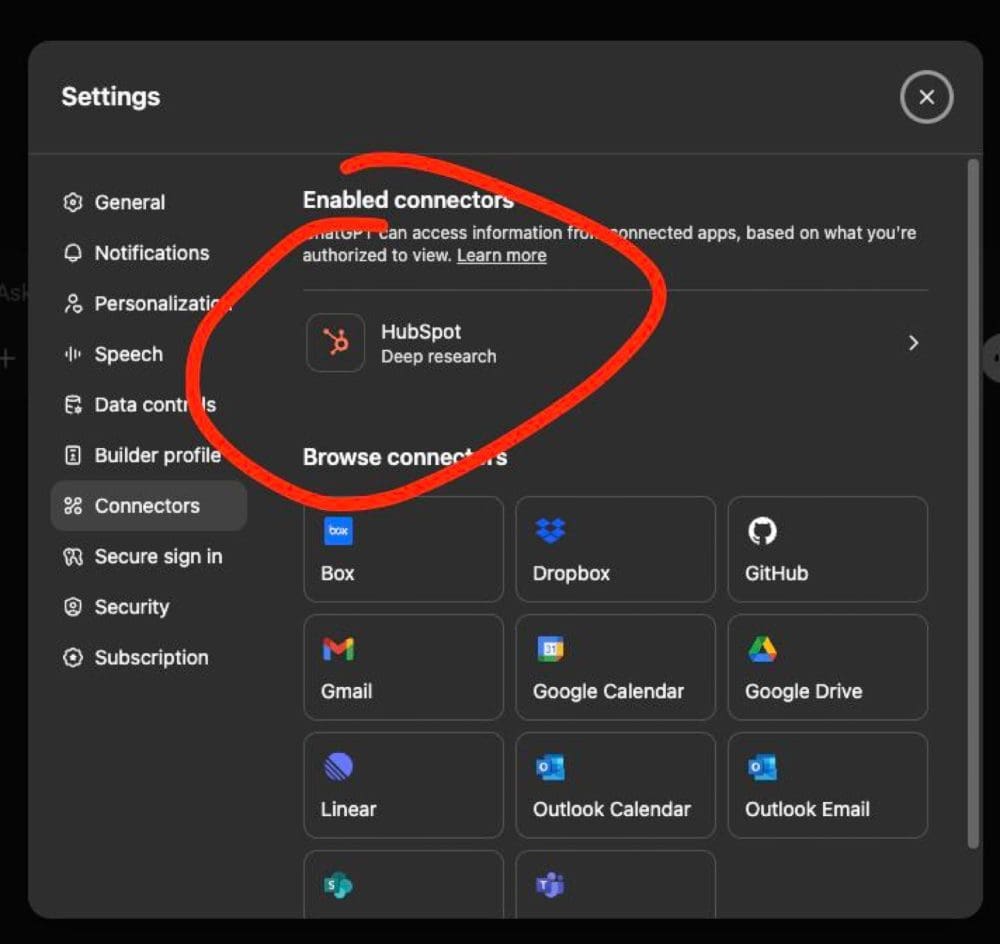
HubSpot’s MCP Integration: The First Great Example. And The Canary in the Coal Mine
HubSpot’s integration with ChatGPT via the Model Context Protocol (MCP) represents the first shot across the bow of the traditional B2B software industry. The first leader to do so, but soon 1000s more will.
This isn’t just another integration—it’s a strategic repositioning.
HubSpot is essentially saying: “We know you don’t want to log into our platform, at least not all the time. Instead of fighting this reality, we’re going to make our entire CRM accessible through the interface you actually want to use.”
Through MCP, ChatGPT can:
- Pull contact and company data directly from HubSpot
- Analyze deal pipelines and sales performance
- Surface insights about lead quality and conversion rates
- Identify at-risk customers and expansion opportunities
But here’s the strategic genius: HubSpot isn’t just making their data available—they’re making their business logic available. The workflows, scoring algorithms, and automation rules that make HubSpot valuable become accessible through natural language.
Quickly, many HubSpot customers will do so much more inside of ChatGPT than outside it.
This is HubSpot betting that in a ChatGPT-first world, being the best-integrated CRM is more valuable than having the best CRM interface.
And they’re probably right.
Some, Many, Will Fight It
Many established vendors will fight ChatGPT and MCP opening up their applications. Just as HubSpot was the first leader to embrace MCP, Salesforce was arguably the first to block others from accessing their data via AI, with Slack:
This likely will be effective — for a while. But new buyers will begin to demand the ability to use ChatGPT and MCP to access their data.
The Death of the Dashboard Economy
The $50B+ dashboard and reporting industry is built on a dated premise: that business users want to stare at static visualizations to extract insights.
ChatGPT will kill or at least maim this entire category.
Instead of building elaborate dashboards that try to anticipate what users might want to know, ChatGPT lets users ask exactly what they want to know, when they want to know it.
Consider the difference:
Dashboard Approach:
- Build 47 different reports
- Update them monthly
- Hope someone finds value
- Pray they’re looking at the right metrics
ChatGPT Approach:
- “Show me the top 3 factors contributing to our customer churn this quarter”
- Get a personalized analysis in 30 seconds
- Ask follow-up questions
- Dive deeper into specific areas
The New B2B Software Hierarchy
In the ChatGPT-centric world, B2B software falls into three categories:
Tier 1: Core Business Logic
- Systems that process transactions (CRM, ERP, HRIS)
- These become “headless” backend services
- Value shifts from interface to data quality and business rules
Tier 2: Specialized Workflows
- Tools for specific functions (design, code, content creation)
- These maintain their interfaces but also expose APIs
- Success depends on ChatGPT integration quality
Tier 3: Interface and Reporting
- Dashboards, reporting tools, business intelligence
- These face existential disruption
- Must evolve or die
The Competitive Moat Migration
If ChatGPT becomes the universal interface, where do competitive moats migrate?
Data Quality: Your ChatGPT is only as good as your underlying data. Clean, structured, contextualized data becomes the differentiator.
Business Logic: The algorithms, rules, and processes that power your business operations become more valuable than the interfaces that expose them.
Integration Depth: How well your systems connect to and enhance the ChatGPT experience determines your defensive position.
Domain Expertise: Subject matter expertise embedded in your data models and business rules becomes harder to replicate.
The ChatGPT-First Enterprise
Forward-thinking companies are already building ChatGPT-first operations:
Sales: “ChatGPT, prepare me for my 2pm call with Acme Corp”
- Pulls recent interactions, deal history, competitive landscape from HubSpot
- Surfaces email exchanges and support tickets
- Suggests talking points based on their current challenges
- Identifies upsell opportunities using CRM scoring algorithms
Marketing: “What’s our most effective customer acquisition channel this quarter?”
- Analyzes attribution across all touchpoints
- Correlates with customer lifetime value from HubSpot
- Recommends budget reallocation based on pipeline data
Operations: “Which projects are at risk of missing their deadlines?”
- Scans all project management tools
- Cross-references with sales commitments in HubSpot
- Identifies resource constraints and dependencies
- Suggests mitigation strategies
The HubSpot integration shows what’s possible when a major B2B platform fully embraces ChatGPT as its primary interface. Users can interrogate their entire sales and marketing operation through natural language, getting insights that would take hours of dashboard navigation to uncover.
The Implementation Roadmap
Phase 1: Basic Integration (Happening Now)
- Connect ChatGPT to 2-3 core systems
- Enable simple Q&A functionality
- Prove value with basic use cases
Phase 2: Workflow Orchestration (Next 6-12 months)
- ChatGPT can execute actions across systems
- Complex multi-step workflows through conversation
- Proactive insights and recommendations
Phase 3: Autonomous Operations (12-24 months)
- ChatGPT manages routine business processes
- Exception-based management model
- Predictive optimization across systems
What This Means for B2B and SaaS Companies
If you’re building B2B software, ChatGPT integration isn’t optional—it’s existential.
Winners will:
- API-first everything, and open up to MCP: Your product becomes a backend service
- Embrace the conversational interface: Design for ChatGPT consumption
- Focus on data quality: Clean, structured data becomes your moat
- Build for orchestration: Enable complex workflows through simple prompts
- Follow the HubSpot playbook: Deep MCP integration that exposes business logic, not just data
Losers will:
- Protect their interfaces: Trying to force users into their dashboards
- Ignore the integration imperative: Staying in their silos
- Compete on UI/UX: When the interface is commoditized
- Optimize for seat count: When one ChatGPT serves many users
- Treat ChatGPT as a threat: Instead of the platform they need to win on
The Pricing Model Revolution
If ChatGPT becomes the universal interface, traditional SaaS pricing models break:
Per-seat pricing becomes irrelevant when one ChatGPT session can serve multiple users.
Feature-based pricing shifts to data access and API call limits.
Usage-based pricing aligns with actual value delivered through ChatGPT interactions.
Platform fees emerge for deep ChatGPT integration and orchestration capabilities.
The Security and Governance Challenge
When ChatGPT becomes your universal control plane, it also becomes your universal attack surface.
New security considerations:
- ChatGPT has access to everything—how do you limit blast radius?
- Conversation logs contain sensitive business data
- AI hallucinations could trigger incorrect business actions
- Audit trails become conversational, not transactional
Governance requirements:
- Who can ask what questions?
- How do you ensure data consistency across systems?
- What happens when ChatGPT makes mistakes?
- How do you maintain compliance in a conversational environment?
The Talent Implications
New roles emerging:
- Conversation Architects: Design optimal ChatGPT workflows
- Business Graph Engineers: Maintain data relationships across systems
- AI Prompt Specialists: Craft queries that deliver maximum value
Traditional roles evolving:
- Business Analysts: From report builders to question designers
- IT Administrators: From system managers to conversation orchestrators
- Data Engineers: From ETL to real-time business graph maintenance
The Network Effects
As more business systems connect to ChatGPT, the value compounds exponentially:
- More data sources = More comprehensive insights
- More users = Better conversation patterns and responses
- More integrations = Higher switching costs
- More workflows = Deeper business process optimization
ChatGPT becomes the business operating system—and like all operating systems, it gets stronger with every application that runs on it.
The Bottom Line
ChatGPT isn’t just changing how we interact with business software—it’s fundamentally restructuring the business software industry.
HubSpot’s MCP integration is the writing on the wall. When a $30B+ SaaS company bets their future on ChatGPT integration over interface innovation, every other B2B software company should pay attention.
The future isn’t about building better business applications. It’s about building better business backends that serve the ChatGPT frontend.
Companies that understand this shift will build the next generation of enterprise software. Those that don’t will find themselves building increasingly sophisticated interfaces that nobody uses.
The conversation revolution isn’t coming. It’s here. And ChatGPT is leading it.
HubSpot just showed everyone the playbook. The only question is: are you building for the ChatGPT-first enterprise, or are you still just building for the dashboard-driven past?


